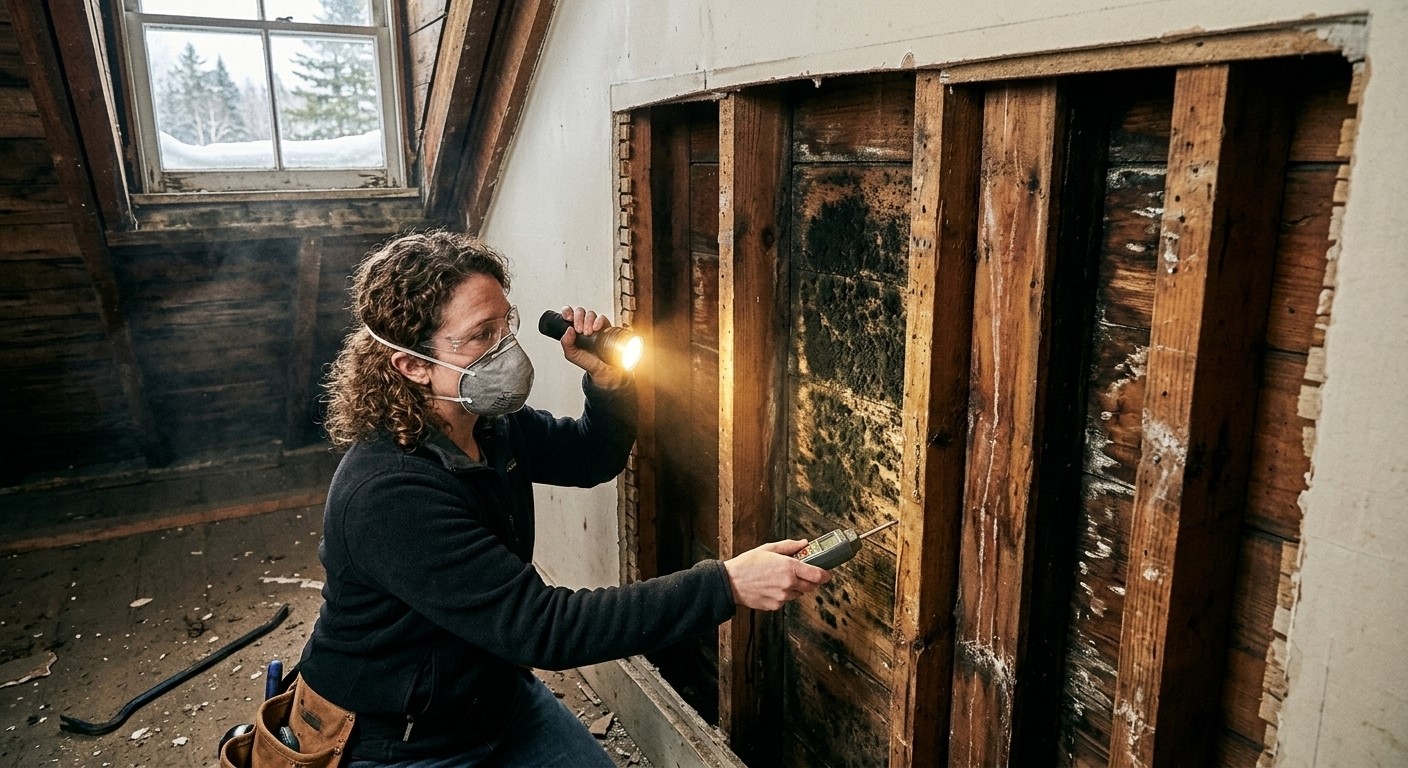
Maine homes built before 1940 carry a structural characteristic that creates ideal conditions for hidden mold growth — open wall cavities running uninterrupted from the basement to the attic. This construction method, known as balloon framing, allows kitchen steam and bathroom humidity to travel directly to the attic where cold temperatures cause condensation, saturating old-growth lumber and feeding Stachybotrys, Penicillium, and Aspergillus colonies that can grow undetected for years. According to Maine Monitor's 2025 housing analysis, 23.4% of Maine's 741,803 housing units were built before 1940 — nearly double the national average of 12% — making this one of the most widespread and underrecognized mold risks in the state.
Quick Answer
Maine homes built before 1940 almost universally use balloon framing — a construction method with open wall cavities running from basement to attic with no moisture breaks between floors. These cavities act as invisible moisture shafts: kitchen steam and bathroom humidity travel directly to the attic, condense on cold sheathing, and feed hidden black mold colonies — often for years before any visible sign appears. The "old books" or "damp basement" smell in a specific room is frequently the first detectable signal. If you notice this in a pre-1940 Maine home, call (877) 360-5502 for a professional infrared mold inspection serving all Maine counties.
Key Takeaways
- 23.4% of Maine homes were built before 1940 — nearly double the U.S. national average of 12%
- Balloon frame cavities have no fire stops or moisture breaks between floors — open from basement to attic
- Kitchen and bathroom steam travels directly to the attic through open stud bays
- Knox County has the highest concentration of pre-1940 homes in Maine at 33.3%
- The "only at home" allergy pattern is a documented mold exposure indicator
- Infrared thermal imaging locates hidden moisture without opening walls — saving $5,000–$15,000 in unnecessary demolition
- Early inspection: $229–$475 | Delayed full remediation: $10,000–$18,000+
- (877) 360-5502 — certified inspectors serving Portland, Lewiston, Bangor, Biddeford, and all Maine counties
Warning Signs: Does Your Maine Home Have This Problem?
Hidden mold in balloon-framed homes rarely announces itself with visible colonies — it announces itself with symptoms that most homeowners attribute to other causes. Recognizing these early indicators in a pre-1940 Maine home determines whether you're dealing with a $1,500 targeted remediation or a $15,000 structural problem.
The "Old Books" or Musty Smell in a Specific Room
The earthy, musty odor described as "old books," "damp basement," or "wet forest floor" in a specific room of an old Maine home is almost always a biochemical signal from active mold colonies growing inside the wall structure. Mold releases microbial volatile organic compounds (mVOCs) — primarily geosmin and 1-octen-3-ol — during active colonization, and the human nose detects these compounds at concentrations as low as 5 parts per trillion, weeks before any visible growth appears.
Two patterns are particularly characteristic of balloon frame mold in Maine homes. First, the smell is localized — strongest in one room, often the kitchen or an adjacent bedroom — because the source is inside that specific wall cavity. Second, the odor intensifies in winter mornings after a night with the heating system running and windows closed, when stack effect airflow through the cavity is at its highest.
An earthy smell without a visible source in a pre-1940 Maine home is not a cosmetic or ventilation issue. It is a confirmed signal of active microbial activity inside the building structure.
The "Only at Home" Allergy Pattern
Respiratory symptoms — nasal congestion, coughing, eye irritation, or worsening asthma — that are consistently present at home and consistently absent when traveling or spending time outdoors represent a recognized mold exposure pattern documented by the CDC. This "only at home" pattern is particularly significant in older Maine homes because the exposure source is continuous and enclosed.
Symptoms typically worsen in winter when windows remain closed and heating-driven stack effect maximizes airborne spore circulation through the wall cavities. Children, elderly residents, and individuals with asthma or compromised immune systems exhibit symptoms first and most severely. The CDC estimates indoor mold exposure contributes to approximately 21% of asthma cases in the United States — a statistic with particular relevance in Maine's aging housing stock.
If an allergist cannot identify an external allergen and symptoms improve whenever you leave the home for more than 48 hours, the source is almost certainly inside the building structure.
Physical Signs on Walls, Ceilings, and Attic
Beyond smell and health symptoms, balloon frame moisture accumulation leaves physical evidence that, when identified correctly, points directly to the cavity moisture problem:
- Paint bubbling or peeling on exterior walls with no corresponding exterior water source — moisture is pushing outward from inside the cavity
- Yellow or brown staining on plaster or drywall at wall-ceiling junctions, particularly in kitchens and bathrooms
- Cold spots on interior wall surfaces in winter — areas where moisture has accumulated inside the cavity and reduced thermal performance
- Dark staining or visible mold colonies on attic roof sheathing — the terminal point where cavity moisture condenses and accumulates
- Soft, discolored attic rafters — structural lumber that has sustained extended moisture exposure
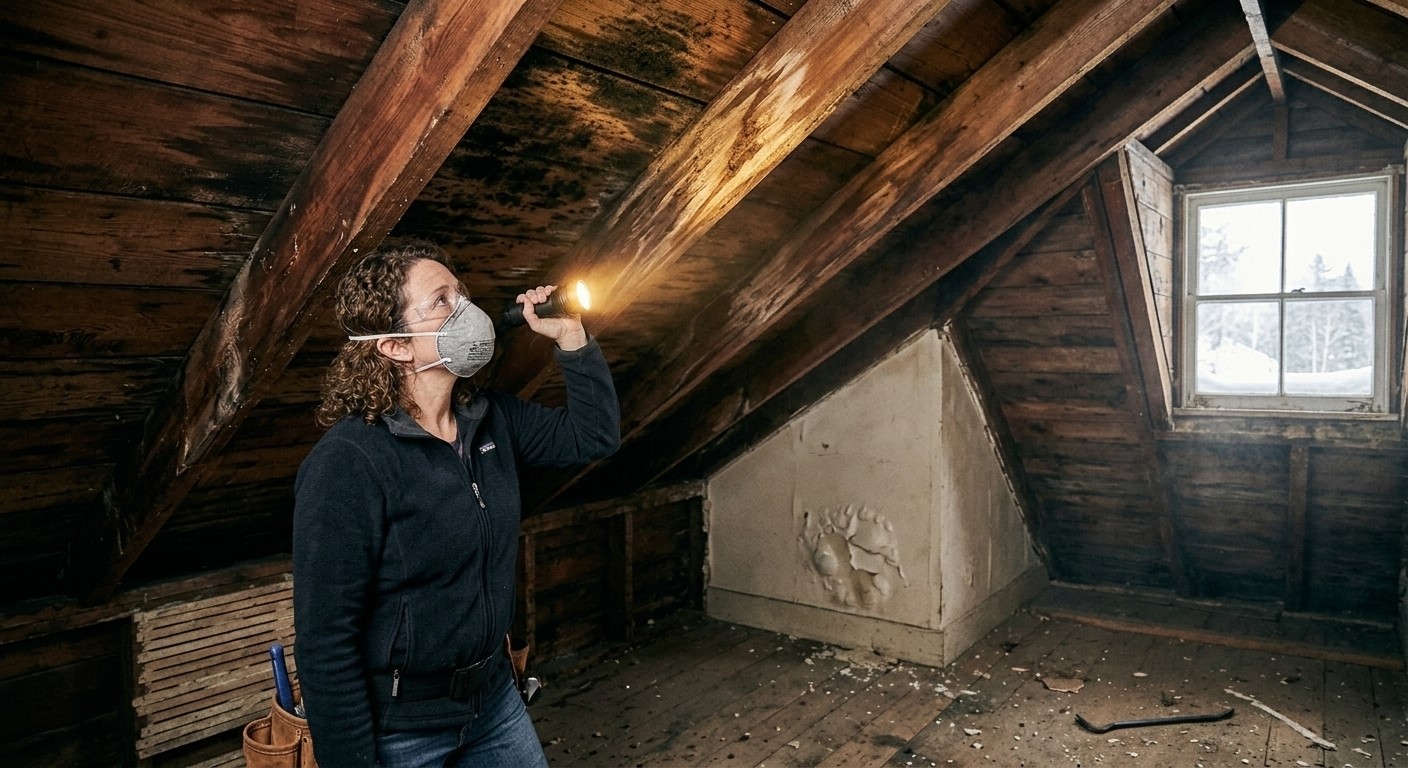
Any visible mold in the attic of a pre-1940 Maine home should be treated as evidence of an active moisture pathway, not an isolated surface problem.
Noticed any of these signs in your Maine home? Mold colonies double in size every 24–48 hours under humid conditions. Call (877) 360-5502 to schedule a professional inspection — serving all Maine counties.
5-Minute Self-Inspection: Is Your Maine Home at Risk?
Before scheduling a professional inspection, four quick checks can establish whether your home has balloon frame construction and active moisture pathways. This self-assessment does not replace professional infrared testing, but it provides immediate clarity on the level of risk.
Step 1 — Confirm the Build Year
Any Maine home built before 1940 should be treated as balloon-framed until confirmed otherwise. Build year appears on the property deed, county assessment records, and most MLS listing histories. Maine county property records are publicly searchable through the Maine Registry of Deeds — Cumberland, York, Androscoggin, Penobscot, and Kennebec counties all provide online access.
Step 2 — Inspect the Attic for Open Wall Cavities
Access the attic with a flashlight and examine where the exterior walls meet the attic floor. In platform-framed homes (post-1940), a continuous horizontal plate blocks the top of each stud bay — you see solid wood, no opening. In balloon-framed homes, the stud bays are open at the top — you can see directly down into the wall cavity, sometimes all the way to the floor below. This open gap is the moisture highway.
Step 3 — The Smoke Test for Stack Effect
Hold a lit incense stick or smoke pencil near the open top of a wall cavity in the attic during winter, when the heating system is active. In a home with active stack effect:
- Smoke is visibly drawn downward into the cavity — warm air inside is pulling air upward through the stud bays
- The stronger the draw, the more intense the moisture transport from living spaces to attic
A neutral smoke test does not rule out the problem — it means the differential pressure is low at that moment. The test is most reliable on cold days when the indoor-outdoor temperature gap is largest.
Step 4 — The 7-Sign Checklist
Use this checklist to assess your specific risk level before calling for an inspection:
□ Home built before 1940
□ Musty, earthy, or "old books" smell in a specific room
□ Paint bubbling or staining on walls without visible water source
□ Respiratory symptoms or allergies only at home
□ Dark staining or visible mold on attic sheathing
□ Indoor humidity above 60% RH in winter
□ Open wall cavity tops visible in attic

3 or more signs → Professional infrared inspection warranted
5 or more signs → Active mold colony highly probable
What Is Balloon Framing — and Why Maine Has So Much of It
Balloon framing is a structural construction method in which wall studs run continuously from the foundation sill to the roof plate — spanning two, three, or even four stories in a single uninterrupted member. This design eliminates the floor-by-floor structural breaks that define modern platform framing, leaving the interior of every exterior wall as a continuous open air channel from the basement to the attic.
A Construction Method Born in 1833
Balloon framing was developed in Chicago in 1833 and became the dominant residential construction method across the United States almost immediately. It required less skilled labor than traditional timber framing, used standardized dimensional lumber, and could be erected significantly faster. By the 1870s, virtually all residential construction in New England, the Midwest, and the Mid-Atlantic used balloon framing.
The method remained dominant until World War II, when platform framing — in which each floor is built as a separate enclosed unit — became the standard. Platform framing created automatic horizontal fire stops and moisture breaks between floors, eliminating the open cavity problem that defines balloon framing. Any home built between approximately 1833 and 1940 was almost certainly constructed with balloon framing unless specifically documented otherwise.
Maine's Housing Stock — By the Numbers
Maine's housing stock reflects the state's industrial and demographic history in direct and measurable ways. According to The Maine Monitor's 2025 analysis of aging housing inventory, 23.4% of Maine's 741,803 housing units were built before 1940 — compared to the national average of approximately 12%. Maine ranks 8th nationally for the oldest housing stock by percentage.

Broader context makes the scale of the problem clearer: 54% of all Maine housing was built before 1980, meaning more than half of all residential structures in the state predate the widespread adoption of vapor barriers, modern insulation practices, and mechanical ventilation standards. Pre-1940 balloon-framed homes represent the most vulnerable segment of this already aging inventory.
Highest-Risk Counties in Maine
Risk concentration varies significantly by county, reflecting historical patterns of industrial development and settlement:
| County | % Pre-1940 Homes | Key Cities and Towns |
|---|---|---|
| Knox County | 33.3% | Rockland, Camden, Thomaston, Vinalhaven |
| Cumberland County | ~28% | Portland, South Portland, Westbrook |
| York County | ~25% | Biddeford, Saco, Kennebunk, Sanford |
| Androscoggin County | ~24% | Lewiston, Auburn |
| Penobscot County | ~22% | Bangor, Brewer, Old Town |
| Kennebec County | ~21% | Augusta, Waterville, Gardiner |
Knox County's 33.3% figure — the highest in Maine — reflects the concentration of Victorian-era coastal homes in Rockland, Camden, and Thomaston, combined with a maritime climate that adds 15–20% relative humidity above inland Maine averages. This combination of old construction and persistent coastal moisture creates the most intensive balloon frame mold risk environment in the state.
The Invisible Moisture Highway: From Kitchen to Attic
Hidden mold in balloon-framed Maine homes develops through a specific, repeatable physical mechanism — one that operates continuously during every Maine heating season. Understanding this mechanism explains why the problem is so commonly missed and why standard visual inspection consistently fails to identify it.
The Stack Effect in Maine Winter Conditions
The stack effect describes the tendency of warm air to rise and escape through the upper envelope of a building, drawing replacement air in through lower openings. In any heated building during cold weather, warm interior air is less dense than cold exterior air — creating a pressure differential that drives continuous upward airflow through the building structure.
Maine's climate produces some of the most intense stack effect conditions in the continental United States. The combination of indoor heating temperatures (+18–22°C) and outdoor winter temperatures that regularly reach -10 to -20°C creates a large and sustained pressure differential. This differential is greatest during October through April — Maine's heating season — when the problem is most active and most damaging.
How Balloon Frame Cavities Amplify the Problem
In a modern platform-framed home, the stack effect moves air through gaps around windows, electrical outlets, and ceiling penetrations — significant, but limited. In a balloon-framed home, the effect is dramatically amplified by the open stud bays themselves.
Every exterior wall cavity functions as a dedicated air channel. Warm, humid air from the kitchen rises through the wall cavity behind the stove or sink. Bathroom steam rises through the adjacent cavity. This air — carrying moisture — travels the full height of the building and reaches the cold attic, where it contacts the roof sheathing at temperatures well below the dew point. The moisture condenses. Old-growth lumber absorbs it. With wood moisture content above 19%, mold colonization begins. According to the EPA's mold guidelines, relative humidity above 60% and temperatures between 40°F and 100°F are sufficient to sustain active mold growth — conditions that exist continuously inside Maine attics during the heating season.
The 4 Critical Moisture Accumulation Zones
Moisture does not distribute evenly in a balloon-framed home. It concentrates at specific points along the pathway:
- Behind the kitchen exterior wall — the first condensation zone, where warm moist air first contacts the cooler wall cavity surface
- Wall cavity between floors — accumulation zone where moisture dwells longest and where Stachybotrys chartarum (black mold) most commonly establishes
- Roof sheathing in the attic — the terminal condensation point; in severe cases, visible frost forms on sheathing in January and February and melts repeatedly, saturating the wood
- Around chimney penetrations — where the chimney mass creates a thermal bridge, accelerating condensation and trapping moisture in surrounding cavities
Which Maine Neighborhoods Face the Highest Risk
The geographic concentration of balloon-framed housing in Maine follows the state's industrial history. Mill towns, port cities, and Victorian-era residential neighborhoods built to house industrial workers contain the highest densities of pre-1940 construction — and consequently, the highest concentration of balloon frame mold risk.
Portland — Munjoy Hill, West End, and Bayside
Portland's oldest residential neighborhoods contain the highest concentration of balloon-framed homes in Cumberland County. Mold remediation in Portland, ME involves some of the most structurally complex cases in the state, given the age and density of the housing stock.
Munjoy Hill — Portland's easternmost peninsula neighborhood — contains the densest concentration of triple-deckers and two-family homes in the city, most built between 1880 and 1920. The neighborhood's exposure to ocean air from the east compounds moisture accumulation in these already-vulnerable structures.
The West End contains Portland's oldest Victorian residential stock, with many homes dating to 1870–1900. These properties combine balloon framing with original plaster-and-lath wall systems — configurations that hold moisture more aggressively than drywall and are significantly more difficult to remediate.
East Bayside and Bayside were developed as working-class residential neighborhoods in the late 19th century. The construction density and original use as rental housing means many properties received minimal maintenance over their lifespans, compounding moisture accumulation over decades.
Lewiston-Auburn — Mill Worker Housing
Lewiston and Auburn represent the most concentrated mill-era balloon frame housing stock in Maine outside Portland. The Bates Manufacturing Company's expansion from the 1850s through the early 1900s drove mass construction of worker housing in the neighborhoods surrounding the mill complex — virtually all of it balloon-framed. Mold remediation in Lewiston, ME frequently involves these densely built, minimally modified structures.
Little Canada — the French-Canadian immigrant neighborhood north of the Bates Mill — retains the highest concentration of original mill-era housing in the city. Many properties here have never been substantially renovated, meaning original balloon frame cavities remain completely open from basement to attic.
Biddeford-Saco and York County
York County's approximately 25% pre-1940 housing rate reflects the textile mill history of Biddeford and Saco. Downtown Biddeford and the Saco Island area contain multi-family mill worker housing from 1870–1920 — structurally identical to Lewiston's stock. Mold remediation in Biddeford, ME in these neighborhoods typically involves wall cavities that have channeled kitchen moisture to the attic for 80 to 100 years without interruption.
Kennebunk and Kennebunkport present a different risk profile: Victorian-era single-family homes used as seasonal rental properties. Seasonal vacancy combined with uncontrolled humidity and heating cycles creates accelerated moisture accumulation relative to owner-occupied primary residences.
Bangor and Penobscot County
Bangor's development as a center of the 19th-century lumber trade produced extensive residential construction between 1860 and 1930 in the West Side, Downtown, and Broadway neighborhoods. Mold remediation in Bangor, ME frequently involves four-square and Craftsman bungalow-style homes from this period — both construction types built with full balloon framing.
Knox County — The Highest-Risk Area in Maine
Knox County's 33.3% pre-1940 housing rate represents the highest concentration of balloon-framed homes of any county in Maine. Rockland, Camden, and Thomaston contain dense concentrations of Victorian residential construction dating to the lime quarrying and shipbuilding industries of the 1860s–1900s. These homes face a compounded risk: original balloon frame construction combined with a maritime climate that maintains relative outdoor humidity above 70% for significant portions of the year. In practical terms, Knox County homes experience higher baseline wall cavity moisture than any other region of Maine — making the stack effect moisture pathway more damaging and more persistent.
Why Standard Inspection Misses Hidden Mold in Balloon Frame Homes
Visual inspection identifies surface mold — colonies that have grown large enough and moisture-damaged enough to penetrate wall or ceiling surfaces. In balloon-framed homes, this represents the final stage of a problem that began years earlier inside the wall structure, where no visual inspection reaches.
The Limits of Visual Assessment
The EPA's guidance on mold remediation in schools and commercial buildings establishes the 10 square foot threshold for professional remediation — but notes explicitly that hidden mold cannot be visually measured or assessed. An inspector who identifies visible mold in an attic and recommends attic remediation alone, without investigating the moisture pathway through the wall cavities below, has addressed the symptom while leaving the cause entirely intact.
In balloon-framed Maine homes, the wall cavity itself is the primary mold environment. The attic is where the evidence becomes visible; the kitchen wall is where the problem originates. Remediation that addresses only the attic while leaving open cavity pathways intact will result in recurrence within one to three heating seasons.
What Infrared Thermal Imaging Reveals
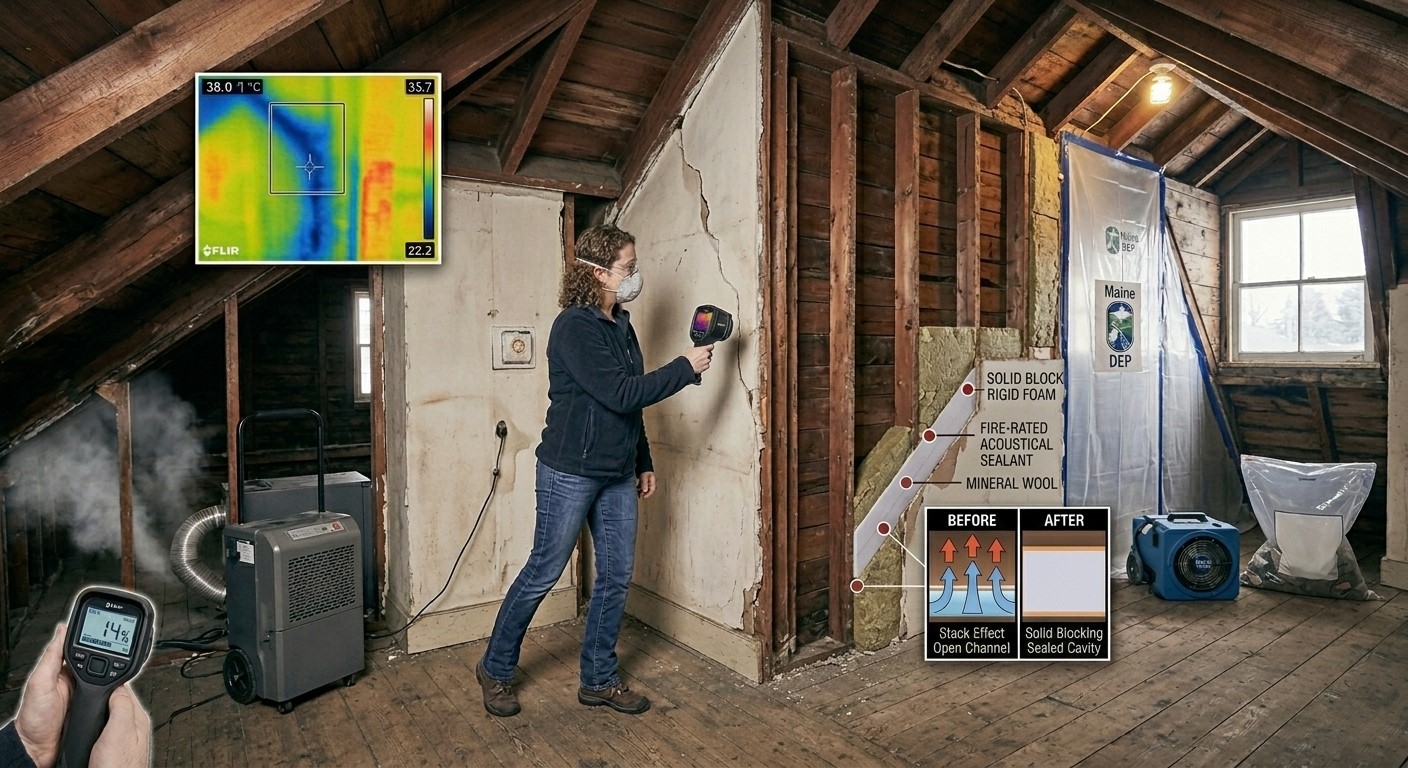
Infrared thermography detects temperature differentials on wall and ceiling surfaces that indicate moisture accumulation within the building structure. Wet or moisture-saturated building materials have different thermal mass and conductivity than dry materials — they appear as distinct cool zones on an IR camera during winter when the building envelope is under thermal stress.
In a balloon-framed Maine home, an IR scan during cold weather will typically show:
- Cool vertical bands on exterior walls corresponding to moisture-saturated stud bay cavities
- Thermal irregularities at floor-ceiling junctions where moisture has migrated laterally
- Cold zones at attic floor level where saturated insulation has reduced thermal performance
- Pathway mapping from kitchen or bathroom locations to attic — the complete moisture route made visible
This mapping capability is the critical operational difference between visual inspection and infrared assessment. IR scanning determines exactly which wall sections require demolition and which do not — directly controlling remediation scope and cost.
Air Sampling as Diagnostic Confirmation
Infrared imaging identifies moisture location and extent. Air sampling confirms mold species and spore concentration, which determines remediation protocol. Stachybotrys chartarum (black mold) requires different containment and material disposal procedures than Penicillium or Aspergillus species. Professional laboratories analyze air samples collected from the wall cavity environment against outdoor baseline samples — a methodology consistent with the American Industrial Hygiene Association standards for indoor air quality assessment.
The Solution: Infrared Assessment + Targeted Demolition + Drying
Effective remediation of balloon frame mold in Maine homes follows a four-phase process. Each phase is dependent on the previous — skipping or abbreviating any phase increases the probability of recurrence.
Phase 1 — Infrared Moisture Mapping
A certified inspector with an infrared camera conducts a systematic scan of all exterior walls, interior walls adjacent to wet areas, and the attic structure. The scan produces a thermal map identifying every zone of active moisture accumulation and establishing the pathway from source to attic.
The inspection includes air sampling at identified moisture zones and baseline outdoor air sampling for comparison. A written report documents findings with thermal images, moisture meter readings at identified zones, and a recommended remediation scope with specific wall sections identified for demolition.
- Duration: 2–4 hours for a typical Maine single-family home
- Cost range: $229–$475
- Output: Thermal map, air quality report, remediation scope
Phase 2 — Targeted Tearout
Demolition is limited to the wall sections identified in the IR report — not full wall systems, not adjacent areas not confirmed as affected. Before any demolition begins, the work area is sealed with polyethylene containment barriers under negative air pressure using HEPA-filtered air scrubbers. This containment prevents spore dispersal into the rest of the occupied structure during the work.
Remediation technicians remove plaster or drywall and any structural lumber with moisture content above 19% or visible mold colonization. All removed materials are bagged in sealed poly bags and disposed of according to applicable Maine waste disposal requirements. The Maine Department of Environmental Protection provides guidance on proper disposal of mold-contaminated building materials for contractors operating in the state.
Phase 3 — Drying and Antimicrobial Treatment
Following demolition, industrial desiccant dehumidifiers are placed inside the opened wall cavities and adjacent spaces. Desiccant systems — rather than standard refrigerant dehumidifiers — are used in Maine's cold climate because they maintain effective moisture removal at temperatures below 65°F, where refrigerant systems lose efficiency.
Moisture content in exposed structural lumber is monitored daily. Work does not proceed to closure until all structural members test below 15% wood moisture content, consistent with the IICRC S520 Standard for Professional Mold Remediation. Following drying, an EPA-registered antimicrobial agent is applied to all exposed surfaces to address residual spore contamination.
- Duration: 3–7 days depending on moisture saturation levels
- Completion criterion: Wood moisture content ≤15% throughout affected area
Phase 4 — Draft Stopping (The Step Most Contractors Skip)
Draft stopping — the installation of solid blocking material within the now-open wall cavities between floor levels — is the single most important step for preventing recurrence, and the step most commonly omitted by contractors who focus on remediation without addressing the underlying structural cause.
Without draft stopping, the repaired wall is mold-free — but the cavity that caused the problem remains open. The stack effect resumes on the first cold day of the following heating season. Within one to three years, moisture accumulation and mold colonization return in the same location.
Effective draft stopping uses mineral wool (vapor-permeable, fire-resistant) or rigid foam with all edges sealed with fire-rated acoustical sealant. Blocking is installed at each floor level within the wall cavity, eliminating the continuous air channel that defines balloon frame construction. This single measure fundamentally changes the thermal and moisture dynamics of the wall system.
Cost Ranges for Maine Homeowners
The following cost ranges reflect typical remediation scope for Maine residential properties. Actual costs vary based on the extent of moisture saturation, number of affected wall sections, accessibility, and mold species confirmed by air sampling.
| Scenario | Affected Area | Estimated Cost Range |
|---|---|---|
| Early detection, single wall section | <10 sq ft | $1,500–$4,000 |
| Moderate — 2–3 sections + attic surface | 10–50 sq ft | $4,000–$10,000 |
| Extensive — multiple cavities, structural involvement | 50–100 sq ft | $10,000–$18,000 |
| Severe — structural damage, full cavity system | >100 sq ft | $18,000+ |
The cost differential between early and late intervention is primarily driven by structural lumber replacement — once old-growth dimensional lumber is structurally compromised, it requires replacement rather than remediation, adding significant labor and material cost. An infrared inspection at the first sign of musty odor in a pre-1940 Maine home represents the most cost-effective intervention at every income level.
Early detection significantly reduces remediation scope and cost. Call (877) 360-5502 to schedule an infrared mold inspection — certified technicians serving Portland, Lewiston, Bangor, Biddeford, and every Maine county.
Frequently Asked Questions
How do I know if my Maine home has balloon framing? If your home was built before 1940, balloon framing is almost certain. Confirm by accessing the attic and examining where the exterior walls meet the attic floor. In balloon-framed homes, the stud bays are open at the top — you can see directly down into the wall cavity. In platform-framed homes, a continuous horizontal plate closes the top of each bay.
Can I smell mold before I can see it in an old Maine home? Yes. mVOC gases — responsible for the musty "old books" or earthy odor — are released during early-stage mold colonization, weeks to months before any visible growth appears on wall surfaces. A persistent musty smell in a specific room of a pre-1940 Maine home, particularly one that intensifies in winter or in the morning, warrants professional inspection.
Is the mold in my Maine attic coming from the kitchen? In balloon-framed homes, yes — the kitchen-to-attic pathway is one of the most consistently documented moisture routes in this construction type. Kitchen steam and bathroom humidity enter open wall cavities and rise to the attic via stack effect. Attic mold in a pre-1940 home that shows no evidence of roof leaks almost always originates from below via this pathway.
How much does an infrared mold inspection cost in Maine? Professional infrared thermal imaging inspections in Maine typically range from $229 to $475 for a residential property, including the moisture mapping report and air sampling analysis. This cost is directly proportional to the accuracy of any subsequent remediation — IR-guided targeted tearout typically costs 40–60% less than non-guided remediation of the same problem.
Does Maine homeowner's insurance cover balloon frame mold remediation? Coverage depends on the specific policy language. Sudden and accidental water damage is commonly covered; long-term moisture accumulation from a structural cause — which describes balloon frame mold — is typically excluded from standard policies. A professionally documented infrared inspection report establishing the moisture pathway and timeline supports insurance claims where coverage may apply. Consult your policy documentation and insurer directly for coverage determinations.
Will ventilation or a dehumidifier resolve the problem? Improved ventilation and dehumidification reduce ambient humidity in the living space but do not address existing mold colonies inside wall cavities or eliminate the structural moisture pathway. These measures slow the progression of an active problem but do not constitute remediation. Certified remediation and draft stopping are required for a durable resolution.
Which Maine neighborhoods have the highest concentration of balloon frame homes? Munjoy Hill, West End, and East Bayside in Portland; Little Canada and the Bates Mill area in Lewiston; Downtown Biddeford and Saco Island in York County; the West Side and Broadway area in Bangor; and virtually all pre-1940 residential areas in Knox County — where 33.3% of all housing units predate 1940, the highest rate of any Maine county.
Schedule Your Inspection Before the Next Heating Season
Act Before Conditions Worsen
Maine's heating season — October through April — creates peak conditions for balloon frame moisture accumulation. Each heating cycle moves humid air from living spaces through open wall cavities to the attic, compounding existing moisture damage and expanding active mold colonies. Structural lumber that has sustained two or three additional seasons of moisture exposure after initial mold establishment typically requires replacement rather than remediation — a cost difference of several thousand dollars per affected wall section.
Mold does not resolve without intervention. Certified technicians perform infrared thermal imaging inspections, targeted remediation, and draft stopping in residential and commercial properties across all Maine counties.
Serving: Portland · Lewiston · Bangor · Biddeford · Rockland · Augusta · and all Maine counties
(877) 360-5502