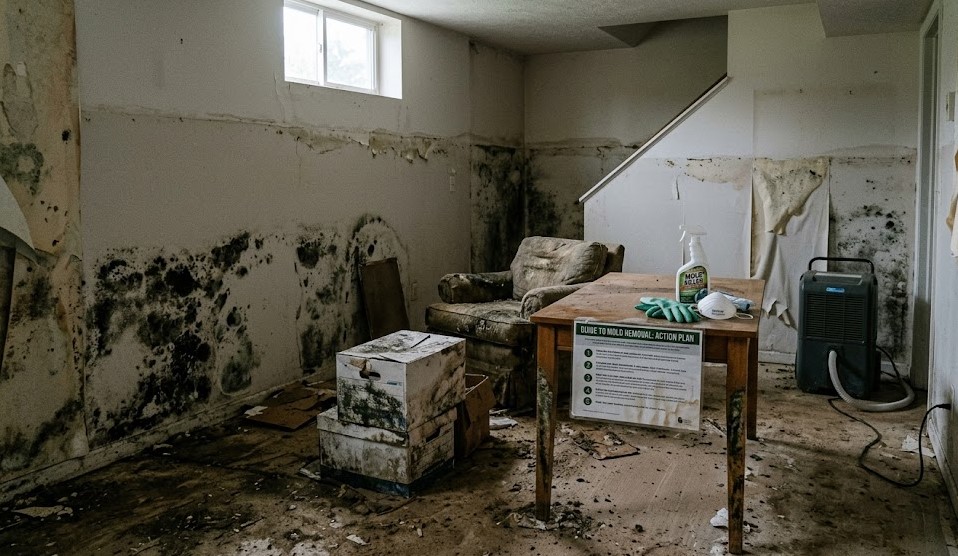
Mold growth begins within 24–48 hours of water contacting organic building materials — drywall paper, wood framing, insulation, and subfloor components. If your home in Georgetown, Round Rock, Cedar Park, San Antonio, Schertz, or Cibolo sustained water intrusion during the April–May 2026 flood events, active mold colonization is plausible even in areas that appear visually dry. Central Texas's warm temperatures and elevated post-flood humidity create conditions that accelerate this process significantly.
Quick Answer
- Mold growth is documented to begin within 24–48 hours of sustained water contact with organic materials
- Hidden colonization — inside wall cavities, beneath flooring, behind baseboards — is the most common post-flood presentation
- The EPA recommends professional remediation when visible mold coverage exceeds 10 square feet
- Standard Texas homeowner's insurance policies typically exclude flood-related mold damage; separate flood coverage through NFIP is required
- Running standard fans when mold is already present may disperse spores to unaffected areas
- A returning musty odor after initial cleanup is consistent with an unresolved moisture source
How Quickly Does Mold Develop After Flood Damage?
Mold colonization begins within 24–48 hours when water contacts organic building materials under conditions of elevated humidity and temperature. According to EPA guidance on mold cleanup after disasters, this timeline applies to porous materials including drywall, wood framing, carpet padding, and cellulose insulation. By the time surface discoloration or odor is detectable, the underlying colony is typically well established.
The structural characteristics common to Central Texas residential construction create specific risk factors. Slab-on-grade foundations — standard across San Antonio, Georgetown, Schertz, and Cibolo — have no subfloor drainage path. Water that enters the living space has no exit route from beneath flooring systems, and moisture trapped between a concrete slab and laminate or luxury vinyl plank flooring can remain elevated for weeks. Georgetown's limestone substrate drains surface water relatively quickly, which may create a misleading impression of resolution while moisture persists inside wall assemblies.
Conditions That Accelerate Growth in This Region
- Ambient temperatures of 75–90°F during April and May fall within the optimal range for rapid spore germination and colony development
- Post-flood indoor relative humidity commonly remains above 80%, well above the 60% threshold cited in EPA indoor air quality guidance
- Enclosed wall cavities and spaces beneath flooring maintain elevated humidity even after surface materials appear dry to the touch
- Limited air circulation in interior closets, under-cabinet spaces, and garage storage areas prolongs drying timelines
What Happened in Central Texas in April–May 2026
Two significant flood events affected the region within approximately ten days of each other, producing the sustained moisture conditions that create post-flood mold risk.
April 20–21 — Georgetown and Williamson County
The South Fork San Gabriel River rose from 7 to 13.7 feet in under 12 hours on April 21. Williamson County Emergency Management documented 44 road closures spanning Georgetown, Round Rock, Cedar Park, Leander, and Jarrell. Twenty families were evacuated from Shady River and Good Water RV parks along the river corridor. County assessments recorded damage to 65 residential structures and 74 public facilities, with Georgetown's infrastructure loss estimate reaching approximately $9.6 million. These figures represent direct structural damage; secondary impacts from water intrusion into residential buildings are not fully captured in public damage assessments.
April 30 – May 1 — San Antonio and Bexar County
The National Weather Service San Antonio office issued a Flood Watch for Bexar County and surrounding areas beginning April 30, with rainfall totals of 2–4 inches broadly and isolated totals approaching 6 inches in some areas. Approximately 30 road closures were recorded across San Antonio by the morning of May 1. Schertz-Cibolo-Universal ISD canceled school operations. One fatality was confirmed — a man recovered from San Pedro Creek near South San Marcos Street. Governor Abbott amended the state's active disaster proclamation on April 30 to incorporate additional affected counties.
For homeowners in the affected areas, the elapsed time since these events — now several weeks — places the current situation in a window where hidden mold colonization is a realistic concern warranting active assessment.
Where Mold Develops After Flooding — Locations Homeowners Consistently Miss
Post-flood mold most commonly develops in enclosed, low-airflow spaces where moisture persists after surface water is removed. These areas are not detectable through visual inspection alone and require moisture measurement equipment to assess accurately.
Hidden Risk Zones in Slab-On-Grade Construction
The following locations warrant specific attention in homes built on concrete slabs — the predominant residential construction type across San Antonio, Georgetown, Schertz, and Cibolo:
- Beneath flooring systems — moisture trapped between a concrete slab and LVP, laminate, or tile grout lines has no evaporative pathway and may remain elevated for weeks
- Lower wall cavities behind baseboards — water wicks upward into drywall paper and wood framing through capillary action, often extending 24–36 inches above the visible water line
- Interior corner closets — reduced airflow and thermal bridging concentrate moisture in these locations
- Garage areas near water heaters and mechanical equipment — particularly in garages that experienced standing water
- HVAC air handlers and duct systems — water intrusion into return air pathways can introduce spores into the distribution system, potentially spreading contamination throughout the structure
- Under-sink cabinets and appliance connections — areas that are rarely inspected and where particle board construction accelerates deterioration
Cases involving garages that held standing water warrant particular attention. Drywall in garage walls is frequently unprimed or unpainted, making it more absorbent. Stored cardboard, fabric, and organic materials in this space present additional colonization substrate that homeowners often overlook until odor becomes apparent.
Material Assessment: What to Remove and What May Be Salvageable
Any porous material that sustained water contact for more than 24–48 hours and cannot be dried to below the moisture content thresholds specified in IICRC S520 should be treated as non-salvageable. Visual assessment of these materials is insufficient — surface appearance does not reflect internal moisture levels or subsurface colonization.
Materials That Should Be Removed
- Carpet and carpet padding — these materials cannot be reliably dried to safe moisture levels following flood exposure and represent a primary colonization substrate
- Drywall that was in contact with floodwater — typically the lower 2–4 feet of any affected wall, depending on water depth and duration
- Fiberglass batt and cellulose insulation — both retain moisture within their structure even after surface drying
- Upholstered furniture, mattresses, and box springs
- Cardboard storage boxes and organic materials in affected spaces
- Particle board and MDF cabinetry that absorbed water
Materials That May Be Assessed for Retention
- Rigid foam board insulation — non-porous and potentially cleanable if exposure duration was limited; assessment by a qualified remediator is warranted
- Ceramic tile and grout — the tile surface itself is non-porous; however, adhesive and substrate materials beneath may retain moisture and require investigation
- Solid wood furniture on legs — potentially salvageable if dried within approximately 24 hours of exposure and showing no surface mold
- Metal appliances and tools — cleanable per CDC guidance using an unscented bleach solution (1 cup per 1 gallon of water) on non-porous surfaces
The application of bleach to porous materials such as drywall or wood framing is not recommended by EPA guidance. Bleach addresses surface contamination on non-porous substrates but does not penetrate the material depth where hyphal structures are established.
Actions That May Expand the Scope of Damage
The following actions are commonly observed in the post-flood period and are associated with worsened outcomes.
- Delaying water extraction and drying — at ambient temperatures above 75°F and relative humidity above 70%, organic building materials do not dry passively within the timeframe needed to prevent mold initiation
- Operating standard box fans in the presence of visible mold — air movement disperses spores to unaffected areas; this applies to both oscillating fans and HVAC systems if contamination has reached ductwork
- Enclosing wall assemblies before moisture clearance — installing new drywall over framing that has not reached equilibrium moisture content seals active colonization within the wall cavity
- Applying paint or sealant over damp substrates — surface coating does not arrest subsurface growth; colonization typically becomes visible again within weeks
- Discarding damaged materials before documentation — insurance adjusters and FEMA assessors require physical or photographic evidence of damage prior to disposal
- Applying bleach to drywall or wood framing — addresses surface presentation only and may provide a misleading impression of remediation completeness
When Professional Remediation Is Required
DIY mold cleanup is appropriate under specific, limited conditions: affected area under 10 square feet, non-porous substrate, no evidence of hidden moisture, and no vulnerable occupants. These conditions are less common following a significant flood event than homeowners typically expect.
The EPA's published guidance establishes 10 square feet as the threshold above which professional remediation is recommended. This guidance is available in the EPA Mold Cleanup in Your Home document.
Indicators That Warrant Professional Assessment
- Visible mold coverage exceeding 10 square feet in any single area
- Persistent musty odor without an identifiable visible source — this pattern is consistent with colonization inside wall assemblies or beneath flooring
- Mold presence at or near HVAC components
- Water intrusion that persisted for more than 24–48 hours without active mechanical drying
- Water from sewage backup or externally contaminated sources (Category 3 water damage under IICRC classification)
- Occupants include children, elderly individuals, pregnant women, or persons with respiratory conditions or compromised immune function — CDC guidance notes that these populations may be more susceptible to mold-associated health effects
- Prior cleanup attempt followed by return of musty odor — this pattern strongly suggests the primary moisture source or colonization area was not fully addressed
If any of the above conditions apply, schedule a professional mold assessment before conducting further cleanup.
Regulatory Framework and Official Guidance
Texas has specific licensing requirements for mold-related work that differ from general contractor regulations.
- The Texas Department of Licensing and Regulation (TDLR) separately licenses Mold Assessment Consultants and Mold Remediation Contractors — these functions must be performed by independently licensed professionals
- Under Texas law, the firm performing assessment cannot be the same entity performing remediation unless both licenses are held independently within that organization
- Remediation work in Texas must follow a written Mold Remediation Protocol prepared by a licensed assessor prior to work initiation
- The IICRC S520 Standard for Professional Mold Remediation defines industry-accepted protocols for containment, removal, drying, and clearance — verify that any contractor references this standard
- FEMA advises thorough documentation of all damage prior to any cleanup activity to support disaster assistance and insurance claims
- The Texas Department of Insurance recommends prompt claim filing; NFIP flood claims are typically subject to a 60-day filing window from the date of loss
Verify contractor licensing status through the TDLR License Search before authorizing any assessment or remediation work.
Insurance Coverage for Flood-Related Mold in Texas
Standard homeowner's insurance policies in Texas typically exclude damage resulting from flooding, including mold that develops as a direct consequence. Coverage for flood-related mold damage generally requires a separate flood insurance policy, most commonly issued through the National Flood Insurance Program (NFIP).
Documentation Steps for Insurance Claims
- Photograph and video all affected areas — walls, floors, ceilings, and personal property — before any materials are moved or discarded
- Retain all damaged materials on-site until your insurer's adjuster has completed their assessment
- Record all expenses associated with emergency response, temporary housing, and mitigation efforts with receipts
- Request a written remediation protocol and post-clearance test report from any remediation contractor — these documents are required by many insurers and will be relevant in any future property transaction
- Contact your insurer promptly; NFIP claims are subject to filing deadlines, typically 60 days from the flood event
If your coverage situation is unclear, the Texas Department of Insurance provides a consumer helpline and published guidance specific to flood claim scenarios.
What Professional Mold Remediation Involves
Professional mold remediation is a structured process governed by IICRC S520 standards. It addresses what visual inspection cannot detect and documents the outcome to a verifiable standard.
| Service Component | Purpose |
|---|---|
| Moisture mapping (IR camera + pin/pinless meter) | Identifies moisture inside wall assemblies, beneath flooring, and above ceilings without destructive investigation |
| Containment installation | Isolates the work zone using physical barriers and negative air pressure to prevent cross-contamination |
| HEPA air filtration | Captures airborne spores generated during removal activity |
| Selective demolition guided by moisture data | Limits tearout to areas confirmed to require it, reducing overall scope |
| Structural drying | Brings framing and substrate materials to equilibrium moisture content — IICRC S520 references ≤15% for wood framing as a general clearance benchmark |
| Antimicrobial treatment | Applied to affected substrates following removal to inhibit recurrence |
| Post-remediation clearance documentation | Written protocol and clearance report for insurance, regulatory, and disclosure purposes |
Moisture mapping prior to demolition is particularly relevant in Central Texas slab-on-grade construction. Without instrument-guided assessment, the extent of moisture migration within wall cavities and beneath flooring is not determinable by visual inspection.
About This Article
The flood events described — Georgetown/Williamson County (April 20–21, 2026) and San Antonio/Bexar County (April 30 – May 1, 2026) — are based on information from public emergency management records, National Weather Service advisories, and local reporting current as of publication. Mold growth timelines and material handling recommendations reflect EPA, CDC, and IICRC published guidance. This article provides general informational content and does not constitute medical, legal, or engineering advice. Individuals concerned about health effects associated with mold exposure should consult a licensed healthcare provider. For mold assessment and remediation, engage a contractor holding current TDLR licensing for the applicable scope of work.
Professional Mold Remediation in Central Texas
If your home sustained water intrusion during the April–May 2026 flood events, a professional moisture assessment is the appropriate next step — regardless of whether visible mold is currently present.
Mold remediation services are available for residential and commercial properties across Central Texas. Select your area to confirm service availability:
Georgetown, TX · San Antonio, TX · New Braunfels, TX · Round Rock, TX · Cedar Park, TX · Schertz, TX · Cibolo, TX
Contact us to schedule a consultation.
Frequently Asked Questions
How long does mold take to grow after a flood? According to EPA guidance, mold growth can begin within 24–48 hours of water contacting organic building materials such as drywall, wood framing, and carpet. In warm, humid conditions — typical of Central Texas in spring and summer — this timeline may be compressed. By the time mold is visible, the underlying colony is typically well established.
Can mold grow inside walls without visible surface signs? Yes. Post-flood mold colonization most commonly develops inside wall cavities, beneath flooring, and behind baseboards — areas where moisture persists and airflow is limited. Surface discoloration or odor are late-stage indicators, not early ones. Instrument-based moisture assessment is the only reliable method for detecting hidden colonization.
Does homeowners insurance cover mold after flooding in Texas? Standard homeowner's insurance policies in Texas typically exclude flood damage and related secondary effects, including mold. Coverage for flood-related mold damage generally requires a separate flood insurance policy through NFIP. Review your specific policy terms and contact the Texas Department of Insurance if coverage questions arise.
What is the EPA's 10 square foot guideline for mold remediation? The EPA recommends that homeowners limit DIY mold cleanup to areas of 10 square feet or less. Areas exceeding this threshold, or any situation involving HVAC contamination, hidden moisture, or vulnerable occupants, warrant engagement of a licensed professional remediator.
How do I detect hidden moisture after flooding? Persistent musty odor, soft or discolored drywall, buckled flooring, and visible condensation on wall surfaces may indicate hidden moisture. Accurate detection requires a calibrated moisture meter or infrared thermal imaging — methods used by licensed mold assessors. Visual inspection alone is not sufficient to rule out moisture in enclosed building assemblies.
What is the difference between mold assessment and mold remediation in Texas? Under Texas law administered by TDLR, mold assessment and remediation must be performed by separately licensed professionals. The assessor develops the remediation protocol; the remediator executes it. These functions cannot be performed by the same individual or firm unless both licenses are independently held. Verify licensing status at the TDLR License Search.
Should fans be used to dry a flooded home? Mechanical airflow is appropriate during initial drying before mold colonization begins. If visible mold is already present, operating standard fans may disperse spores to unaffected areas of the home. HVAC systems should not be operated if there is reason to believe the air handler or ducts were contacted by floodwater, as this can distribute spores throughout the structure.
How long does professional mold remediation take? Project duration depends on the extent of colonization and structural involvement. Limited, well-defined cases may be addressed in one to three days. Projects involving multiple rooms, HVAC components, or extensive structural drying typically require five to ten days from initial assessment to post-remediation clearance. Your licensed assessor will define the scope and timeline in the written remediation protocol prior to work commencement.
Did Your Home Flood in Central Texas?
If it's been days or weeks since the water came in, a moisture assessment is the right next step — before mold becomes a larger structural problem.
Not seeing your city? We serve hundreds of communities nationwide. Call (877) 360-5502 to confirm service availability in your area.