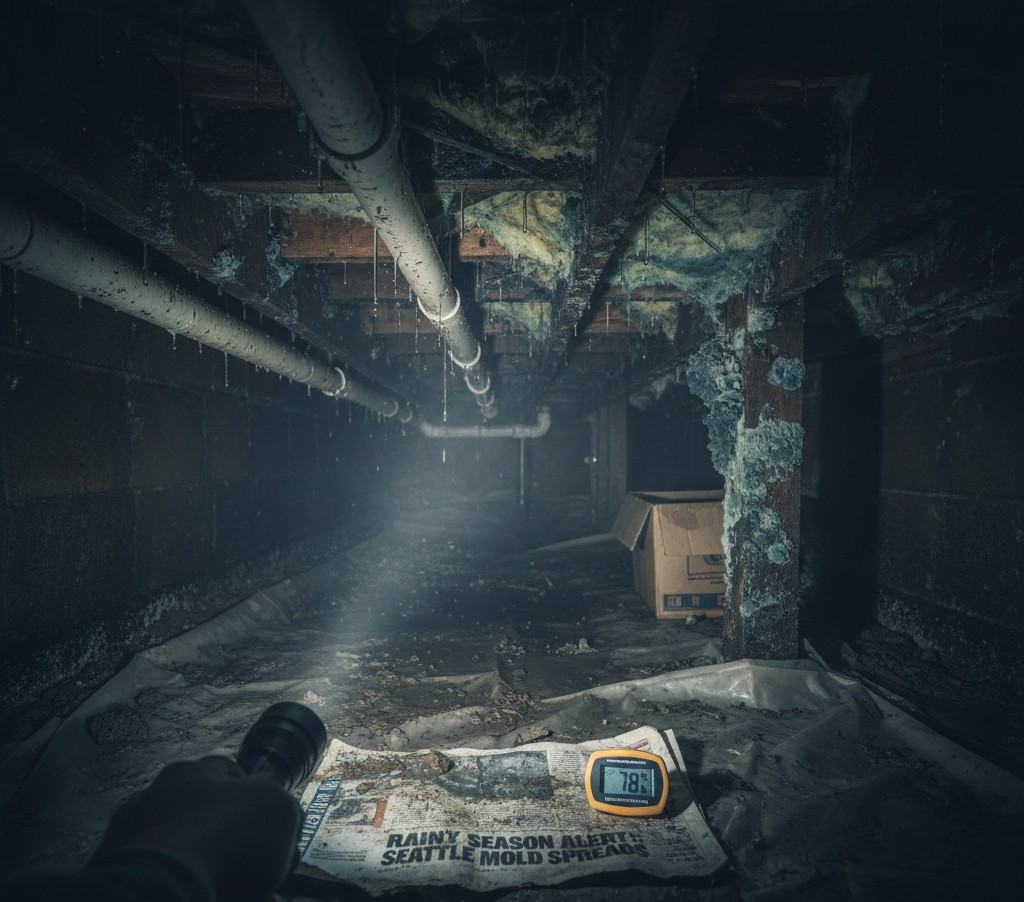
Pacific Northwest homeowners face a hidden threat beneath their homes as winter rains saturate crawl spaces, creating ideal conditions for mold growth within 24-48 hours. Seattle receives over 150 rainy days annually, with persistent drizzle from October through May that saturates soil around foundations and maintains crawl space humidity at 70-80%—well above the 60% threshold where mold thrives. This continuous moisture exposure, combined with marine air humidity, clay soil that traps water for weeks, and older housing stock lacking modern moisture barriers, makes Washington and Oregon crawl spaces among the most mold-prone in the nation.
Approximately 80% of Pacific Northwest homes experience crawl space moisture problems during their lifespan, according to regional building inspectors. These moisture issues lead to wood rot requiring $6,000-$15,000 in floor joist replacement, foundation damage costing $8,000-$25,000 to repair, and mold contamination affecting indoor air quality throughout the home. The problem intensifies each winter as groundwater levels rise, clay soil becomes saturated, and hydrostatic pressure forces water through foundation cracks.
If you detect musty odors, standing water, or sagging floors in your Seattle, Tacoma, or Portland home, call certified mold specialists at (877) 360-5502 for immediate crawl space inspection. Early intervention prevents structural damage and protects your family's health.
Why Pacific Northwest Crawl Spaces Are Mold Magnets
Seattle, Portland, and surrounding Pacific Northwest cities create optimal conditions for crawl space moisture problems through a combination of persistent rainfall, marine humidity, poor soil drainage, and aging housing infrastructure. The region receives over 150 rainy days per year—the National Weather Service documents that Seattle experiences measurable precipitation on 152 days annually on average, with November through March accounting for 60% of annual rainfall. This continuous moisture saturates soil around foundations, creating conditions that persist for weeks after rain stops, unlike regions with sporadic precipitation patterns that allow drying between events.
Climate Factors Unique to Washington & Oregon
Pacific Northwest marine air maintains 65-75% ambient humidity year-round from proximity to the Pacific Ocean, Puget Sound, and numerous water bodies. This elevated humidity exists even without precipitation—the air itself contains substantial moisture that prevents crawl spaces from ever fully drying. When this humid air enters crawl spaces through vents or gaps, it condenses on cooler surfaces including concrete walls at 50-55°F and metal pipes at 45-50°F. The condensation cycle continues regardless of current weather because ambient humidity remains elevated throughout the year.
Portland and Willamette Valley feature clay-heavy soil that absorbs water slowly compared to sandy or loamy soils common in other regions. When winter rains saturate this clay, water has nowhere to percolate downward, creating hydrostatic pressure against foundation walls. Clay soil percolation rates of 0.1-0.5 inches per hour compare to 2-6 inches per hour in sandy soils—this means water remains trapped at foundation level for 3-4 weeks after heavy rain events. This geological reality affects Portland, Beaverton, Eugene, and throughout Oregon's valleys.
During wet months from November through March, groundwater levels rise dramatically throughout the Pacific Northwest, particularly in areas near Puget Sound, Lake Washington, Columbia River, and Willamette River. The United States Geological Survey documents water table fluctuations of 4-8 feet between summer lows and winter highs in western Washington and Oregon valleys. Crawl spaces built below or near the seasonal high water table experience persistent moisture intrusion regardless of surface drainage quality—this affects properties in Georgetown, Interbay, and South Seattle lowlands where groundwater reaches within 2-3 feet of crawl space floors during peak winter months.
Why Pacific Northwest Housing Stock Is Vulnerable
Many homes in Seattle and Portland were built between 1900-1980, before building science recognized the problems with vented crawl space designs in humid climates. Building codes through the 1990s required crawl space ventilation based on research conducted in dry continental climates—the International Residential Code required one square foot of vent area per 150 square feet of crawl space floor. This approach fails in humid climates where ventilation introduces moist air that condenses rather than removing moisture.
Research by Advanced Energy and Oak Ridge National Laboratory has proven that sealed crawl spaces with mechanical dehumidification outperform vented designs in humid climates. The 2015 International Residential Code now recognizes this research, allowing sealed crawl spaces as superior alternatives. Despite this, approximately 60% of Seattle homes and 55% of Portland homes were built before 1980 with construction practices now known to be inadequate: vented crawl spaces allowing humid air entry, inadequate or absent vapor barriers, no foundation drainage systems, zero mechanical dehumidification, and minimal insulation creating temperature differentials that promote condensation.
Seattle's characteristic hillside neighborhoods—Queen Anne, Capitol Hill, Leschi, West Seattle, Magnolia—face accelerated drainage problems as water naturally flows downhill toward foundations. Properties on slopes receive runoff from uphill neighbors in addition to direct precipitation, concentrating water flow that can deposit thousands of gallons at foundations during heavy rain events. Sloped lots throughout Bellevue, Kirkland, and Redmond experience similar challenges requiring superior drainage systems to intercept and redirect water before it reaches foundations.
The Five Moisture Sources in Pacific Northwest Crawl Spaces
Understanding how water enters crawl spaces is essential for implementing effective solutions rather than addressing symptoms while ignoring root causes. Pacific Northwest homes face multiple simultaneous moisture sources, requiring comprehensive approaches that address all entry points.
1. Vapor Intrusion from Soil
Even without standing water or visible dampness, moisture continuously evaporates from soil into crawl space air through vapor intrusion. Soil naturally contains moisture from precipitation that percolated downward, groundwater that rises through capillary action, and humidity absorbed from ambient air. After heavy rain, humidity in unprotected Pacific Northwest crawl spaces reaches 80-90% within 24-48 hours. This water vapor condenses on cooler surfaces—floor joists, subfloor underside, HVAC ductwork, and metal pipes—creating ideal conditions for mold colonization.
The EPA recommends maintaining crawl space humidity below 60% to prevent mold growth. Research by Advanced Energy demonstrates that crawl spaces without vapor barriers in humid climates exceed this threshold 6-8 months annually. A typical 1,000 square foot crawl space with exposed soil releases 10-15 gallons of water vapor daily into the air under Pacific Northwest conditions. Unlike dry climates where soil moisture dissipates between rain events, western Washington and Oregon soil remains damp for weeks after precipitation stops—marine air prevents surface drying while clay soil prevents downward percolation.
2. Groundwater Intrusion
High water tables during winter months push water upward through soil in a process called hydrostatic pressure—the force exerted by water seeking equilibrium. This pressure forces moisture through foundation defects including hairline cracks invisible to the naked eye, porous concrete, mortar joints between concrete blocks, and utility penetrations. The National Association of Home Builders identifies hydrostatic pressure as the leading cause of foundation water intrusion in areas with clay soil and high water tables, where pressure can reach 60-80 pounds per square foot during peak saturation.
Portland-area homes on clay soil experience particularly severe groundwater problems because saturated clay prevents downward drainage, trapping water around foundations. This creates ongoing water intrusion rather than occasional flooding, with moisture continuously entering through foundation walls even weeks after rain stops. Properties within one mile of water bodies—Lake Washington, Puget Sound, Columbia River—experience elevated water tables due to proximity to permanent water sources, with groundwater frequently within 3-5 feet of the surface during winter.
3. Surface Water Accumulation
Poor exterior drainage channels rainwater directly to foundations rather than away from homes. Building codes require ground to slope away from foundations with a minimum 6-inch drop over the first 10 feet, but many older homes never met this standard while others developed negative grading as soil settled over decades. Seattle's evergreen trees—Douglas firs, Western red cedars, hemlocks—shed needles year-round rather than seasonally, creating continuous gutter debris accumulation requiring quarterly cleaning rather than the twice-yearly maintenance sufficient in deciduous climates.
Clogged gutters overflow during rain, dumping hundreds of gallons directly at foundations. A 2,000 square foot roof receiving 1 inch of rain generates 1,250 gallons of water that gutters must handle—water that flows directly to foundations when gutters fail. Downspouts must discharge water minimum 6-10 feet from foundations according to building best practices, yet many older installations discharge within 2-3 feet, depositing roof runoff directly at foundations where it accumulates and penetrates crawl spaces.
4. Plumbing Leaks and Condensation
Crawl space utilities create hidden moisture issues that often go undetected for months. A single dripping pipe releasing one drop per second—barely noticeable without direct observation—introduces over 5 gallons daily. Leaks at pipe joints, corroded copper pipes in older homes, and deteriorated drain seals commonly develop after 20-30 years, coinciding with the age of homes most vulnerable to moisture problems.
Cold water pipes and HVAC supply ducts "sweat" when humid crawl space air contacts their cold surfaces. The dew point—temperature at which air becomes saturated and water condenses—is approximately 55-60°F at 70% relative humidity typical in Pacific Northwest crawl spaces. Cold water pipes commonly maintain temperatures of 45-50°F, well below dew point, creating continuous condensation that drips onto insulation, floor joists, and soil. HVAC supply ducts carrying 55°F conditioned air during summer experience similar condensation, potentially dripping several gallons daily.
5. Damaged or Missing Vapor Barriers
Many Seattle and Portland homes built before 1990 never received vapor barriers during original construction—building codes didn't require them until the 1980s, and enforcement varied by jurisdiction. Homes constructed with vapor barriers frequently have damage from pest activity (rodents and raccoons tearing barriers for nesting sites), UV degradation from light exposure causing brittleness and cracking, poor installation with unsealed seams and gaps, and inadequate material thickness (4-6 mil plastic that tears easily versus modern 10-20 mil commercial-grade barriers).
Without intact vapor barriers covering 100% of soil surfaces, crawl spaces continuously release 10-15 gallons of water vapor daily regardless of external drainage improvements, dehumidifier operation, or ventilation. This makes vapor barriers the foundation of any effective crawl space moisture control system—other measures address additional moisture sources but cannot compensate for exposed soil vapor transmission.
From Moisture to Mold: The 48-Hour Timeline
Mold spores exist naturally in all environments at concentrations of 200-500 spores per cubic meter outdoors. These dormant spores require only moisture, organic material, and moderate temperatures to germinate and colonize. Pacific Northwest crawl spaces provide all three conditions abundantly once moisture intrusion occurs.
Within 24-48 hours after materials become wet, dormant mold spores absorb water and begin germinating when materials exceed 20% moisture content—the threshold established by EPA research as supporting mold growth. This process occurs fastest in Pacific Northwest's moderate temperature range of 45-65°F typical in crawl spaces year-round. Crawl spaces provide abundant organic food sources: untreated wood framing and joists, paper backing on fiberglass insulation, cardboard boxes and storage materials, and accumulated organic dust containing cellulose—mold's preferred nutrient source.
Different mold species germinate at varying moisture thresholds. Aspergillus and Penicillium (the most common crawl space molds) germinate at 20% moisture content and appear as green to yellow-green or blue-green patches. Stachybotrys chartarum (black mold) requires higher moisture levels of 30%+ and colonizes paper-backed materials preferentially, appearing as dark black or greenish-black slimy growth. Cladosporium germinates at lower moisture levels around 18% and commonly appears as olive-green or brown patches on wood.
Within 3-7 days after initial moisture exposure, visible mold colonies appear on damp surfaces as germinated spores form mycelia—the branching network of cells that constitutes mold growth. In crawl spaces, initial growth typically occurs on floor joists and subfloor underside where condensation accumulates first. Growth accelerates exponentially during this phase—a colony occupying 1 square inch on day 3 can expand to 1 square foot by day 7 under ideal conditions of high humidity, continuous moisture, and stable temperatures.
By 2-4 weeks after initial colonization, extensive mold spreads throughout crawl space as millions of airborne spores distribute to all surfaces. At this stage, contamination typically exceeds the 10 square foot threshold that EPA and the Institute of Inspection, Cleaning and Restoration Certification establish as requiring professional remediation rather than homeowner cleaning.
Health and Structural Consequences
Building science research demonstrates that approximately 40% of air in a home originates from the crawl space through "stack effect"—the natural air movement created as warm air rises through the home, creating negative pressure that pulls air upward from below. This means crawl space air quality directly impacts living space air quality. Mold releases spores (3-30 microns in diameter), mycotoxins (toxic compounds produced by certain species), and volatile organic compounds with musty odors. These contaminants circulate through living spaces affecting respiratory health, triggering allergies, and aggravating asthma—the CDC confirms that mold exposure can trigger these symptoms, particularly in children, elderly, and immunocompromised individuals.
Persistent moisture causes wood rot in floor joists and subflooring—structural degradation that compromises load-bearing capacity. The International Code Council establishes that floor joists must support 40 pounds per square foot live load—deteriorated joists fail to meet this requirement. Visible manifestations include sagging or bouncy floors, soft spots in flooring, squeaking and structural movement, and eventual need for floor joist replacement at costs of $6,000-$15,000 for typical projects. Saturated soil loses load-bearing capacity through consolidation, causing foundation settlement and cracking that worsens each rainy season. Foundation repairs range from $8,000 for crack injection and waterproofing to $25,000+ for underpinning and structural stabilization.
If you notice sagging floors, persistent musty odors throughout your home, or visible mold exceeding 10 square feet in your crawl space, call (877) 360-5502 immediately. Early professional intervention prevents structural damage requiring tens of thousands in repairs and protects family health from ongoing mold exposure.
Warning Signs: When Your Crawl Space Has a Problem
Early detection prevents minor moisture issues from escalating into expensive structural repairs and extensive mold remediation. Monitor for these indicators throughout the year, with heightened attention during and after Pacific Northwest's wet season from October through May.
Crawl Space Indicators
Standing water or saturated soil represents the most obvious sign of crawl space problems. Water stains on foundation walls indicate previous flooding or persistent moisture intrusion—look for discoloration, mineral deposits called efflorescence (white, chalky formations), or tide lines showing historical water levels. Efflorescence appears when water carrying dissolved minerals moves through concrete and evaporates on the surface, leaving minerals behind—this indicates active water intrusion under hydrostatic pressure.
Visible mold on wood surfaces appears as patches ranging from white and green to black, with textures varying from fuzzy and cotton-like to powdery or slimy. Common locations include floor joist undersides, subfloor underside visible from below, areas near plumbing or HVAC equipment, and surfaces near foundation cracks or vents. Musty, earthy odors—often detectable at crawl space entrances before visible mold appears—result from mold volatile organic compounds.
Rust on metal components including pipes, HVAC systems, metal support posts, and electrical boxes indicates persistent high humidity exceeding 50% for extended periods. Condensation droplets on pipes, HVAC ducts, or metal surfaces during warm months signal that air humidity exceeds dew point temperature on these cold surfaces, creating continuous condensation that drips onto surrounding materials.
Torn, displaced, or missing vapor barrier sections expose soil allowing vapor intrusion. Inspect barriers for continuity, proper overlap at seams, attachment at walls, and sealing around penetrations. Rodent droppings, carpenter ant trails with sawdust piles, and termite mud tubes on foundation walls indicate pest presence attracted to moisture-damaged wood—these pests accelerate structural damage beyond moisture effects alone.
In-Home Warning Signs
Persistent musty smell in lower-floor rooms, especially when HVAC systems operate, indicates crawl space mold contamination circulating through ductwork or via stack effect. The odor typically intensifies during heating season when greater temperature differentials increase stack effect air movement. Worsening allergies or respiratory symptoms when home that improve significantly when away for extended periods suggest indoor air quality problems from mold exposure—children and elderly often show symptoms first due to greater sensitivity.
Bouncy or sagging floors, particularly in room centers away from walls, indicate compromised floor joist support from moisture damage. Floors should feel solid and level underfoot—any springiness, excessive deflection when walking, or visible sagging requires immediate investigation. Soft spots in flooring signal localized subflooring deterioration from moisture exposure. Doors that stick, won't close properly, or show increasing gaps indicate foundation settling from soil saturation and loss of bearing capacity.
Reduced heating efficiency with persistently cold floors despite adequate insulation indicates heat loss through floor systems. Higher utility bills without usage changes may result from HVAC systems running longer to compensate for moisture-related heat loss. Cold air drafts from floor areas during winter, particularly around plumbing penetrations and along exterior walls, indicate air leaks from crawl spaces introducing cold, humid air.
Emergency Indicators Requiring Immediate Action
Call (877) 360-5502 for 24/7 emergency response if you observe standing water covering significant crawl space floor area (more than 25%), severe mold growth exceeding 10 square feet, sagging floors or visible structural deterioration, foundation cracks wider than 1/4 inch, active water intrusion during rain events, family members experiencing respiratory distress, or sewage backup. These conditions pose immediate health risks or indicate progressing structural damage requiring professional intervention to prevent escalation.
Pacific Northwest Cities Most Affected by Crawl Space Mold
Washington State
Seattle crawl space problems stem from 150+ rainy days annually and marine climate maintaining 65-75% humidity year-round. Hillside neighborhoods including Queen Anne, Capitol Hill, Leschi, and West Seattle face accelerated drainage as water flows downhill, while Georgetown and SODO occupy historic fill areas with high water tables. Older housing stock—60% built before 1980—typically features vented crawl spaces and missing vapor barriers.
Tacoma receives 39 inches annual rainfall with Commencement Bay proximity affecting humidity and water tables. Lowland areas near waterfront experience particularly high water tables bringing groundwater within 2-4 feet of crawl space floors during winter. North End historic homes built 1890-1920 often completely lack vapor barriers and modern foundation systems.
Bellevue properties on slopes throughout Newport Hills, Somerset, and Eastgate receive surface water flowing from uphill, while Lake Washington shoreline properties experience elevated water tables. Clay soil in Factoria valley creates severe drainage problems requiring sump pump systems for many properties.
Olympia experiences the highest rainfall in the region at 50+ inches annually—35% more than Seattle. Low elevation near Puget Sound increases groundwater problems with saturated soil persisting October through June, requiring more robust moisture control than drier locations.
Oregon
Portland combats 42 inches annual rainfall and notorious clay-heavy Willamette Valley soil. Clay absorbs water 5-10 times slower than sandy soils, keeping foundations wet for 3-4 weeks after heavy rain. Groundwater intrusion affects an estimated 65% of homes according to local building inspectors. Northwest Portland hillside areas combine drainage challenges with historic housing stock, while Southeast Portland near Willamette River experiences high water tables.
Beaverton, Hillsboro, and Tigard share Portland's clay soil on former agricultural land with flat topography preventing natural drainage. Water tables rise 4-6 feet during wet season, bringing groundwater within crawl space floor level for many properties built on valley floors.
Eugene receives 47 inches annually—27% more than Seattle—with Willamette River proximity raising water tables throughout winter. Salem experiences 40 inches rainfall in mid-valley location with poor natural drainage, where many homes built 1950s-1970s lack adequate moisture protection.
Get Crawl Space Help in Your Area
Our certified mold remediation specialists serve homeowners throughout Washington and Oregon with comprehensive moisture assessment and permanent solutions.
Washington: Seattle | Bellevue | Tacoma | Kirkland | Redmond | Renton | Issaquah | Sammamish | Kent | Auburn | Federal Way | Olympia | Everett | Spokane | Vancouver
Oregon: Portland | Beaverton | Hillsboro | Tigard | Gresham | Lake Oswego | Salem | Eugene | Springfield | Corvallis
When to Call Professional Help: (877) 360-5502
Certain crawl space conditions exceed DIY capabilities and require professional expertise, specialized equipment, and industry certifications. Active flooding or standing water covering more than 25% of crawl space floor area requires immediate professional water extraction preventing material damage and mold growth within 24-48 hours. Professional equipment removes hundreds of gallons hourly—far exceeding homeowner wet-vacuum capabilities.
Mold covering more than 10 square feet represents the EPA threshold requiring professional remediation rather than homeowner cleaning. At this contamination level, proper remediation requires containment preventing spore distribution, HEPA filtration of work areas, and complete removal of contaminated materials. Black mold (Stachybotrys chartarum) requires professional remediation regardless of area due to mycotoxin production creating health risks.
Sagging or bouncy floors indicate compromised floor joist support requiring immediate structural assessment. Wood moisture content exceeding 28% supports decay fungi that digest wood cellulose causing rot—professional assessment determines repair requirements ranging from sister joisting to complete joist replacement. Foundation cracks wider than 1/4 inch or showing progressive widening indicate active foundation movement requiring structural engineer evaluation.
Persistent respiratory issues in household members, aggravated asthma or allergies worsening at home, or unexplained health symptoms may result from mycotoxin exposure requiring source identification and professional remediation. Children and elderly receive priority attention due to greater vulnerability.
Professional Services for Pacific Northwest Conditions
Comprehensive moisture assessment uses thermal imaging detecting hidden moisture, professional moisture meters quantifying water content in materials, and hygrometer testing measuring ambient humidity. This identifies all moisture sources including vapor intrusion, groundwater, surface water, plumbing leaks, and condensation—not just obvious standing water.
IICRC-certified mold remediation follows established protocols including containment using negative air pressure, HEPA filtration capturing airborne spores, complete removal of contaminated materials, antimicrobial treatment of structural members, and post-remediation air quality testing verifying successful removal. Documentation provides records for insurance claims and property disclosure requirements.
Our Pacific Northwest specialists understand regional challenges including marine air humidity management, clay soil drainage solutions, hillside property water control, and older home retrofitting. We're licensed contractors in Washington and Oregon with IICRC certification in water damage restoration, mold remediation, and applied structural drying.
We provide inspections including thermal imaging and moisture mapping, 24/7 emergency response for flooding and severe mold, direct insurance coordination handling claims paperwork and adjuster meetings, and transparent pricing with detailed written estimates. Projects exceeding $5,000 qualify for financing options with approved credit.
Call (877) 360-5502 now for expert crawl space assessment. Don't let Pacific Northwest moisture destroy your home's foundation and your family's health. January through March represent peak crawl space crisis months when groundwater reaches annual highs and contractors book out 4-6 weeks in advance. Act now before spring inspection season creates delays.
FAQs: Crawl Space Mold Problems in Pacific Northwest
Why does my crawl space stay wet even when it hasn't rained?
Pacific Northwest marine air maintains 65-75% ambient humidity year-round regardless of precipitation. This humid air enters crawl spaces through vents and gaps, condensing on cooler surfaces like concrete walls at 50-55°F and pipes at 45-50°F. Additionally, groundwater from previous rains takes 2-4 weeks to dissipate through clay soil—water remains trapped at foundation level long after surface drying. Vapor intrusion from damp soil continuously releases 10-15 gallons daily into crawl space air, a 24/7 process occurring year-round regardless of weather.
Is crawl space ventilation good or bad in Seattle?
Ventilation worsens moisture in Pacific Northwest humid climates. Traditional advice developed in dry climates where outside air humidity (20-40%) was lower than crawl space humidity. In Seattle and Portland, marine air humidity (65-75%) is often higher than crawl space air. Opening vents allows this humid air to enter where it condenses on cooler surfaces, creating more moisture than ventilation removes. Building science research by Advanced Energy and Oak Ridge National Laboratory establishes that sealed crawl spaces with dehumidification outperform vented designs in humid climates. The 2015 International Residential Code recognizes this, allowing sealed crawl spaces as superior alternatives.
How quickly does mold grow after water damage?
Mold begins growing within 24-48 hours after materials become wet and exceed 20% moisture content according to EPA research. Visible colonies appear within 3-7 days as germinated spores form surface growth. By 2-4 weeks, extensive colonization spreads throughout crawl spaces as millions of airborne spores distribute to all surfaces. This rapid timeline makes immediate action critical—the longer materials remain wet, the more extensive mold contamination becomes. Professional water extraction and drying within 24-48 hours prevents mold growth initiation.
What are the first signs of crawl space mold?
Musty, earthy odors often represent the first sign before visible mold appears—these odors result from mold volatile organic compounds. Worsening allergies or respiratory symptoms at home that improve when away suggest mold exposure. In crawl spaces, early indicators include condensation on pipes or ducts, damp or compressed insulation, and water stains on foundations. Visible mold appears as white, green, or black patches on wood surfaces with fuzzy, powdery, or slimy textures. If mold exceeds 10 square feet, EPA requires professional remediation rather than homeowner cleaning.
Does homeowners insurance cover crawl space mold?
Most policies cover sudden, accidental water damage from burst pipes or appliance failures including resulting mold if reported promptly. Insurance typically excludes gradual seepage, groundwater intrusion, poor drainage, and maintenance-related issues. If covered event causes mold, remediation may be covered provided damage is reported within policy timeframes (usually 30-60 days) and reasonable steps are taken to prevent mold growth. Document problems immediately with dated photographs, notify insurance promptly, and obtain professional assessment. Call (877) 360-5502 for documentation supporting insurance claims—our written reports and expert opinions help navigate claims processes.
Protect Your Pacific Northwest Home from Crawl Space Moisture
Seattle and Portland's 150+ rainy days annually create relentless moisture pressure on crawl spaces, making them prime environments for mold growth and structural damage without proper protection. The combination of marine air humidity maintaining 65-75% year-round, clay soil trapping water for weeks, and eight-month wet seasons means crawl space problems affect an estimated 80% of Pacific Northwest homes during ownership periods.
Comprehensive solutions address all moisture sources simultaneously—vapor intrusion, groundwater pressure, surface water drainage, humid air infiltration, and condensation. Professional encapsulation creates permanently dry environments protecting your home from wood rot requiring $10,000-30,000 in repairs, foundation damage costing $8,000-25,000, and recurring mold affecting family health.
Regular quarterly inspections during wet season, proactive maintenance including gutter cleaning and drainage verification, and immediate response to warning signs prevent minor issues from escalating into expensive structural repairs. Don't wait until sagging floors indicate advanced damage or pervasive mold requires extensive remediation.
Protect your Seattle or Portland home today. Call (877) 360-5502 for comprehensive crawl space inspection and permanent solutions. We provide 24/7 emergency service throughout Washington and Oregon with inspections, thermal imaging, and direct insurance coordination. Your crawl space is your home's foundation—keep it dry, healthy, and structurally sound with professional Pacific Northwest expertise.