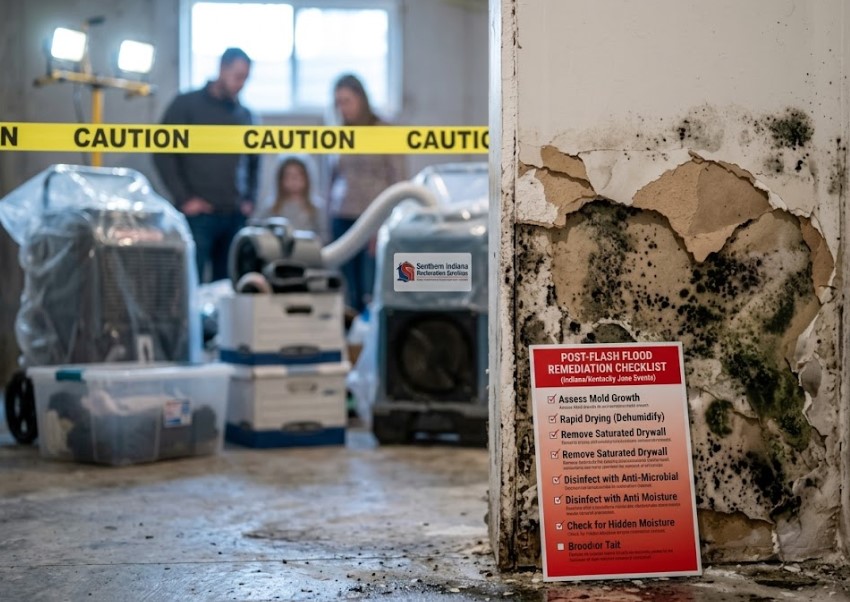
On Tuesday, June 9, 2026, more than eight inches of rain fell on Lanesville, Indiana in a single afternoon. Streets turned into rivers, residents sheltered on rooftops, propane tanks floated through yards, and emergency crews ran water rescues across Harrison County. Nearby Corydon saw businesses and homes inundated, and the flooding strained communities across the Louisville metro on both sides of the Ohio River. Days earlier, the same tropical-moisture pattern had sent floodwater into neighborhoods around Huntsville, Alabama, where first responders pulled drivers from flooded roads.
Key Takeaways
- Mold begins colonizing wet basement materials within 24–48 hours; visible colonies typically appear between day 3 and day 12.
- Floodwater from the June 9 storms is Category 3 ("black") water — soaked carpet, drywall, and insulation should be removed, not dried and kept.
- Concrete that feels dry to the touch can keep feeding mold for weeks — only a moisture meter reading confirms a basement is actually dry.
- The EPA recommends professional remediation for growth over ~10 square feet or after contaminated flooding.
Flash floods in the Ohio Valley have a particular aftermath that Gulf Coast or Texas floods do not: basements. The majority of homes in Kentucky and Southern Indiana have a basement or crawl space, and that is exactly where floodwater — and the mold that follows it — ends up.
Why Basements Turn a One-Day Flood Into a Months-Long Mold Problem
- Water finds the lowest point and stays there. Even after surface flooding recedes, hydrostatic pressure keeps pushing groundwater through foundation walls and floor joints for days. Sump pumps that ran nonstop during the storm often burned out or lost power exactly when they were needed most.
- Older foundations drink water. Much of the housing stock around Louisville, New Albany, and Corydon predates modern waterproofing. Fieldstone and early block foundations absorb water and release it slowly into the basement air for weeks after the flood.
- Finished basements are mold incubators. Carpet on concrete, paneling, drywall over furring strips, stored boxes — all of it holds moisture in a cool, dark space with almost no air movement. Mold colonizes carpet pad and the back side of paneling in 24–48 hours.
- Crawl spaces get forgotten. If your home has a crawl space instead of a basement, floodwater that pooled under the house evaporates upward into the subfloor and joists. Homeowners often discover the problem months later as a musty smell in first-floor rooms or cupping hardwood floors.
What to Do This Week
1. Pump, then keep drying long after it "looks" dry
Remove standing water, but do not stop there. Concrete that took on floodwater can hold moisture for weeks. Run a dehumidifier in the basement continuously, target under 50% relative humidity, and empty or drain it daily. A basement that smells earthy on day 5 has active growth, full stop.
2. Cut your losses on porous materials
After river or storm flooding (which carries sewage, fuel, and farm runoff — Category 3 "black water"), the following cannot be reliably saved and should go: carpet and pad, upholstered furniture that soaked, mattresses, particle-board furniture, cardboard, and any drywall or insulation that got wet. Cut drywall at least 12 inches above the water line. Solid wood, metal, and glass can be cleaned and disinfected.
3. Document for FEMA and insurance before you haul to the curb
Photograph the high-water line in every room, all damaged items, and your furnace, water heater, and electrical panel if they took water. If a federal disaster declaration follows, that documentation supports your FEMA Individual Assistance claim; either way, your insurer needs it.
4. Do not run the furnace or AC blower until ducts are checked
In many Kentucky and Indiana homes the HVAC air handler and ductwork sit in the basement or crawl space. If floodwater reached them, running the blower distributes spores through the whole house. Have the system inspected first.
5. Watch the houses that "only" got a damp crawl space
You do not need a flooded basement to get a mold problem from this event. Saturated ground around the foundation is enough. Check the crawl space with a flashlight now and again in three weeks: white fuzz on joists, a sweet earthy odor, or insulation falling from the subfloor are the early signs.
Who Should Not Be Doing This Cleanup Themselves
Flood mold is a health issue before it is a property issue. According to the CDC, mold exposure can trigger coughing, wheezing, and eye and skin irritation even in healthy adults, and the 2004 Institute of Medicine review linked damp indoor spaces to upper respiratory symptoms and worsening asthma. People with asthma or mold allergies, anyone immunocompromised (chemotherapy, transplant medications, uncontrolled diabetes), people with chronic lung disease, young children, and pregnant women should stay out of a flooded basement entirely.
If you do the cleanup yourself, follow CDC protective guidance: an N95 respirator at minimum, waterproof gloves, goggles without vent holes, and ventilation to the outside while you work. Never mix bleach with ammonia-based cleaners.
When to Call a Professional
The EPA's threshold is about 10 square feet of visible growth — beyond that, or any time flood water was contaminated (it was), professional remediation is recommended. A certified crew sets containment, removes unsalvageable materials safely, dries the structure with commercial equipment, HEPA-vacuums and treats surfaces, and verifies with moisture readings instead of guesswork.
We have certified local teams throughout the flood-affected area:
- Emergency Mold Removal in Corydon, IN
- Basement Mold Removal in New Albany, IN
- Water Damage Mold Removal in Jeffersonville, IN
- Black Mold Removal in Louisville, KY
- Basement Mold Removal in Louisville, KY
- Crawl Space Mold Removal in Lexington, KY
- Mold Inspection in Evansville, IN
- Emergency Mold Removal in Huntsville, AL
- Water Damage Mold Removal in Madison, AL
FAQ
The water is gone and the basement floor is dry to the touch. Am I done?
No. "Dry to the touch" concrete can still read 80%+ internal moisture. Keep dehumidifying for at least two weeks and confirm with a moisture meter, or schedule an inspection — it is the cheapest step in the whole process.
Can I just spray bleach on the basement walls?
Bleach kills surface mold on non-porous material but does not penetrate concrete, mortar, or wood — and it adds water to the surface. On porous materials the roots survive and regrow. Removal of damaged material plus structural drying is what actually works.
How fast does mold really show up after a flood?
Colonization starts in 24–48 hours on wet drywall, carpet pad, and paper-faced materials. Visible colonies typically appear between day 3 and day 12. The smell usually arrives before anything visible does.
What if the flooding happened over a week ago?
The approach shifts from drying to assessment and removal — see our guide: Mold After Flooding: What to Do When Days or Weeks Have Already Passed.
Flooded basement or crawl space after the June storms? Call (877) 360-5502 — 24/7 response across Kentucky, Southern Indiana, and North Alabama.
This article is for general informational purposes and is not medical advice. If you or a family member develop respiratory symptoms after flooding, consult a physician. Health and cleanup guidance referenced from the U.S. EPA and the CDC; flood event details from National Weather Service warnings and local news reports of June 9, 2026.
Published June 13, 2026 · Written by the MoldRM Editorial Team · Reviewed by an IICRC-certified mold remediation specialist